


Kernighan's lever
Brian Kernighan famously wrote:
Everyone knows that debugging is twice as hard as writing a program in the first place. So if you're as clever as you can be when you write it, how will you ever debug it?
— The Elements of Programming Style, 2nd edition, chapter 2
The following version also circulates on the net:
Debugging is twice as hard as writing the code in the first place. Therefore, if you write the code as cleverly as possible, you are, by definition, not smart enough to debug it.
This second quote may or may not be by Kernighan — the questionable use of "by definition" makes me uncertain — but it is useful as a provocative sound bite conveying the same essential idea.
It is tempting to interpret Kernighan's aphorism as a warning: Stay away from clever techniques, it seems to say, because if you write clever code, you will never be able to get it to work. But this interpretation is unfortunate, and rests on the false assumption that cleverness is static.
While it is possible that Kernighan intended us to interpret the message in a specific way, he wisely restricted himself to merely presenting an observation, allowing us to draw our own conclusions from it.
Pay close attention to what is actually being said: Having written code as cleverly as you can, you will suddenly face a problem that you are not clever enough to solve. Certainly, "clever" in this context does not refer to some innate talent, because nobody is born with the ability to write clever code in the first place. The "cleverness" required to write and understand intricate code is an acquired mental skill.
If you are a programmer, you will be familiar with a sense of wonder, gradually transforming into utter stupor, as you stare at some perfectly reasonable code that couldn't possibly fail, and yet somehow it does. And since you are confident that you understand how the code works, having written it yourself, you feel that you must be able to figure out what is going on. Not only the desire to deliver working software on time, but other powerful forces such as pride, stubbornness and curiosity contribute to the motivation that pushes you onwards through the arduous task of tracking down the root cause of the error. Suddenly you see it, and you're blinded by a bright light as all the pieces fall into place. The inexperienced programmer may fall into the trap of self-degradation: "Oh, look at how stupid I was!" But that same sentiment is proof that your programming-related cleverness, or skill, has increased: "Oh, look at how clever I've become!" (Although I wouldn't recommend saying that out loud.)
Skill is the result of practice, that is, of systematically trying to work slightly beyond one's ability. Quite understandably, most of us don't spend that kind of effort unless we have good reason to. Hence, without motivation we do not practise, but simply cruise along at our current level and never improve any further.
The mind is very good at rationalising, and will convince us that our current skills are sufficient, that we are all "good enough"; certainly better than the average programmer anyway. The human brain will do this trick regardless of our actual level of skill. So while we all tend to consider ourselves sufficiently skilled right now, we never regret improving.

You effortlessly wield clever programming techniques today that would've baffled your younger self. (If not, then I'm afraid you stopped evolving as a programmer long ago.) But this improvement is the result of practice, and something must have motivated you to put in all those hours of work. Kernighan's witty remarks provide a clue: In programming, as soon as you work at your current level, you will automatically end up in a situation where you have to work beyond your current level. By means of this very fortunate mechanism, you will leverage several basic human drives (honour, pride, stubbornness, curiosity) into providing the motivation necessary for improvement.
I call this mechanism Kernighan's lever. By putting in a small amount of motivation towards the short-term goal of implementing some functionality, you suddenly end up with a much larger amount of motivation towards a long term investment in your own personal growth as a programmer.
If we deliberately stay away from clever techniques when writing code, in order to avoid the need for skill when debugging, we dodge the lever and miss out on the improvement. We would then need other sources of motivation in order to grow as programmers, and if no such motivation appears, our abilities stagnate (or even deteriorate).
The psychological concept of flow, somewhat simplified, can be used to visualise the process. Flow is when you are "fully immersed in a feeling of energised focus, full involvement, and enjoyment in the process of the activity" (wikipedia), and it only occurs when the challenge that you are tackling matches your current level of skill.
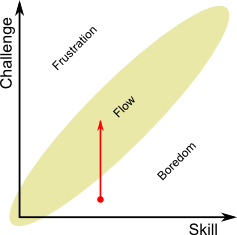
Implement below your ability, and you get to debug in the "flow" area.
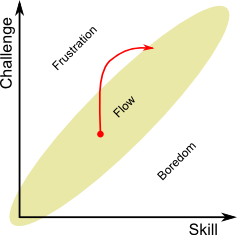
Implement at your ability, and the debugging will be frustrating, but you gain skill.
You will find yourself situated at a particular x-coordinate, corresponding to your current level of skill. If writing code is a point on this graph, then (according to Kernighan's assumption) debugging the same code would be a point a fair bit directly above it.
It is certainly possible to deliberately pick a low starting point just to avoid ending up in the frustration area. But this will put you squarely in the boredom area, and boredom is frankly no better than frustration. However, should you pick a starting point in the enjoyable flow area, Kernighan's lever will screech into action and push you sideways through the graph, increasing your skill until it matches the challenge posed by the bugs in your code.
Naturally, the real world is more complex than this, and you will sometimes have compelling reasons to go for the boring option, and artificially reduce your cleverness in order to dumb down the debugging phase. But it may harm your long-term personal development if you go down that road every single time you write a program.
In conclusion, the answer to Kernighan's rhetorical question — "how will you ever debug it?" — is straight-forward: By tackling the problem, thereby gaining valuable experience and becoming more clever in the process. And the second version of the quote can be adorned with a single word at the end: Yet.
Posted Tuesday 11-Dec-2012 21:33
Discuss this page
Disclaimer: I am not responsible for what people (other than myself) write in the forums. Please report any abuse, such as insults, slander, spam and illegal material, and I will take appropriate actions. Don't feed the trolls.
Jag tar inget ansvar för det som skrivs i forumet, förutom mina egna inlägg. Vänligen rapportera alla inlägg som bryter mot reglerna, så ska jag se vad jag kan göra. Som regelbrott räknas till exempel förolämpningar, förtal, spam och olagligt material. Mata inte trålarna.
Sat 22-Dec-2012 00:10
However, you will be tempted to rewrite it because after those years the code will be rated down into the boring area, so you'll need another 10 years to wait to debug it.
21 more comments hidden. Click to show all.
Mon 29-Dec-2025 03:05
I believe the quote to be influenced in part by his having avoided decent debuggers across his entire career.
Wed 31-Dec-2025 20:00
Given this warning we can make plans for our future selves from our potentially smarter current (historical) self.
The choices will fall into 4 main categories inspired by IT Sec risk management:
- Avoid: We can plan to hide in future by any means
- Outsource: We can plan now to delegate any debugging
- Mitigate: Writing comments and tests: Leverage current IQ
- Accept: Choose to be okay with being dumb in future
Hence, his quote empowers us to choose the challenges we want to face in the future.
Daron Jones - www.daronjones.com
Rishabh
Thu 1-Jan-2026 09:34
Mon 2-Feb-2026 16:53
The only way to maintain obscure or overly clever code is to expose yourself to it, to instrument it, to be humble about what you do not know, and eventually it will be understandeable.
To avoid having to go through such pain, it would have been better to use some clear patterns, like state machines, or good mutex hygiene, or well-tested and dcoumented and named C macros that do one thing well and reliably.
Unfortunately the code was not clever, it used lots of if's, very long chains of them, and simplistic approaches to threading that did not factor commonalities.
Code can be clean, mathematical, clever, so long as it builds on itself, like lemmas towards proofs. Staying flat and simple can be problematic sometimes as well.
I get Kernighan's comment, and I think clever means tricky, like using bit twiddling or taking advantage of peculiarities of the machine or language rather than letting the compiler do simple optimizations.
Thompson wrote something similar about preferring the straighforward algorithm to the overly optimized obscure one in most cases.