



Fratres

Fratres by Arvo Pärt is one of my favourite pieces of music. The analytical meets the aesthetical as Pärt takes us on a meditative, harmonical journey, built up from a simple set of mathematical rules.
Many people who listen to Fratres find it repetitive or even boring at first. After a while, though, they start to unconsciously recognize some of the patterns in the music. In a sense, they develop an intuitive feeling for what comes next in the sequence. Then, if they are the inquisitive, puzzle-solving type of person, they will try to understand the patterns rationally as well. This gradual awakening, whether intended by the composer or not, is perhaps what fascinates me most about Fratres.
I have interpreted Fratres in the form of a dual SID tune.
- Linus Åkesson - Fratres (Arvo Pärt) - Dual SID (MP3, 15.0 MB)
- Fratres DualSID (SID, 7.3 kB)
If you downloaded the SID file, note that there are two subtunes. The first subtune uses arpeggios to play the tune on a single SID chip, whereas the second one (recommended) addresses two SID chips (at $d400 and $d500). To play the dual SID version with sidplay2, include -fd -o2 on the command line.
“The complex and many-faceted only confuses me, and I must search for unity. What is it, this one thing, and how do I find my way to it? Traces of this perfect thing appear in many guises — and everything that is unimportant falls away.”
— Arvo Pärt
The algorithm
Warning! Spoilers ahead. If you enjoy solving puzzles, you may wish to search for these patterns yourself. In any case, I strongly recommend you to listen to the entire piece at least once before reading on.
Have you listened to it now? Good.
Structure
The overall structure of Fratres is simple: Vertically, the piece is divided into two drones (an A and an E that last throughout the piece), three moving voices (low, middle and high) and some percussion (claves and bass drum). Horizontally, ten refuges separate nine segments. Each segment contains a series of chords arranged in some kind of harmonic progression. Between each pair of segments, a recurring, harmonically empty percussion motif — the refuge — offers a moment of contemplation before the next chord sequence.
The following picture illustrates the refuges and segments as a (terribly long) pedestrian crossing. Each segment can be further divided into two halves: The first half consists of falling chords, and the second half consists of rising chords.
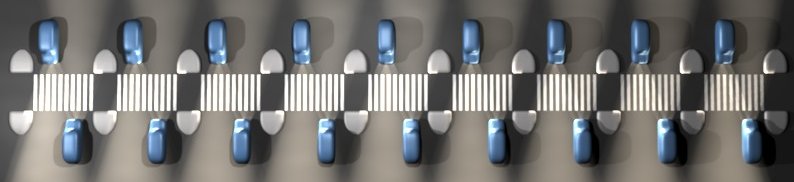
Within each segment half, three voices combine to play a sequence of chords. Each sequence consists of eight different chords played in three different orders (let's call them bars). They are: 1, 2, 7, 8 — 1, 2, 3, 6, 7, 8 — 1, 2, 3, 4, 5, 6, 7, 8. For instance, in the first half of the first segment, the eight chords are: (C#, A, E), (Bb, E, D), (A, E, C#), (G, C, Bb), (F, C, A), (E, C, G), (D, C, F) and (C#, A, E). Thus, in the first bar we get: (C#, A, E), (Bb, E, D), (D, C, F), (C#, A, E).

In order to understand the algorithm behind Fratres, we just need to figure out how to form the eight chords that build up each segment half. That is what the remainder of this article will focus on.
Tintinnabuli
Fratres is composed in the tintinnabuli style invented by Pärt. This basically means that some voices are restricted to playing notes from a particular triad (in Fratres this is the A minor triad), while other voices play melodies.
The drones, A and E, are obviously only playing notes from the A minor triad. The middle voice in the chords is also restricted in this way, so it will only ever play A, C or E in some octave.
The high and low voices, however, play notes from the harmonic D minor scale. Note how the C sharp in the D minor scale contrasts with the C natural in the triad.
The low and high voices
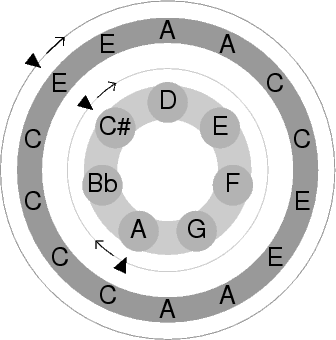
Start with a harmonic D minor scale. Write it out as a circle, like this:
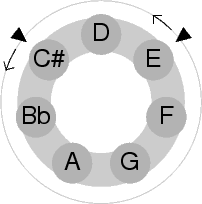
The low voice starts at C#. The high voice starts at E (and is transposed one octave further up). For the eight falling chords (the chords that build up the first half of the first segment), each voice simply moves around the circle, counter-clockwise, until it completes a full revolution at the eighth chord. For the rising chords, we do the same procedure clockwise.
Much like the international date line in the pacific ocean, we add a seam, where the notes get transposed one octave. This will ensure that we end up where we started. To achieve symmetry, this is done when we've come exactly half the way around the circle, i.e. between chords 4 and 5.
The middle voice
As mentioned, the middle voice will only play notes from the A minor triad. Furthermore, the middle voice will by definition play in between the other two voices. But these constraints alone will not be enough to guide the middle voice, so instead we devise a new circle containing the three possible notes:
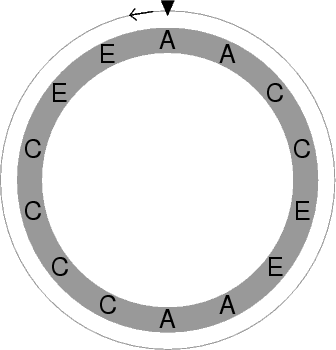
We want the middle voice to sync up to the low and high voices after one complete revolution. Alas, three doesn't divide seven, so we're forced to have some sort of assymmetry in this circle. Pärt has resorted to using four consecutive C:s, as can be seen in the lower left part of our circle.
Why four consecutive C:s? We can only speculate, but my personal theory is this: The ethereal, timeless sound of this whole piece is partly due to the fact that it lingers somewhere in between A minor and A major. This delicate balance is maintained using the C natural from the triad and the C sharp from the melodic voices. By choosing to duplicate the C in the middle voice circle, one prevents the piece from tilting too far towards A major.
All right, but why not double the other C group, the one in the upper right part of the circle? That's easy. If we did that, then the middle voice would end up playing C natural at the same time as another voice would be playing C sharp. That would be too dissonant.
Just like the low and high voices, the middle voice traverses the circle counter-clockwise during the first half of a segment, and clockwise during the second half. Both these journeys begin at the indicated note, e.g. the top A for segment one. But this circle contains fourteen notes rather than seven, so the middle voice does not play its own retrograde in the second half like the low and high voices do.
Spinning the wheels
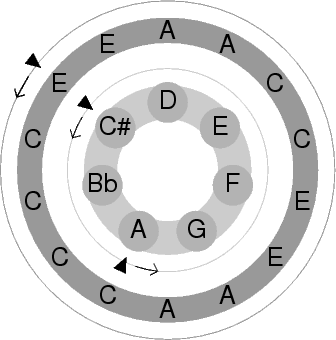
To get the low, middle and high voices for the following segments, we simply move each starting point two steps around the circle, in the counter-clockwise direction. The following diagrams show the starting points for the falling and rising halves of segment number two.
| Second segment, falling half: | Second segment, rising half: |
|---|---|
|
|
This rotation, two steps at a time, continues for the entire set of nine segments. Thus, segments 1 and 8 will be identical, as will segments 2 and 9.
And that is how you extract beautiful, complex harmonic content out of a simple formula.
Posted Monday 3-Dec-2007 06:52
Discuss this page
Disclaimer: I am not responsible for what people (other than myself) write in the forums. Please report any abuse, such as insults, slander, spam and illegal material, and I will take appropriate actions. Don't feed the trolls.
Jag tar inget ansvar för det som skrivs i forumet, förutom mina egna inlägg. Vänligen rapportera alla inlägg som bryter mot reglerna, så ska jag se vad jag kan göra. Som regelbrott räknas till exempel förolämpningar, förtal, spam och olagligt material. Mata inte trålarna.
Edgar
Fri 21-Dec-2007 06:35
40 more comments hidden. Click to show all.
Sat 11-Feb-2017 14:13
Whose version is this?
Mon 12-Jun-2017 15:13
Actually Pärt was born in Paide, Estonia and was raised in Rakvere in northern Estonia.
Mon 5-Aug-2019 00:57
Although A-C sounds correct, A-A is what is happening. The chord in question (beat 3 of bar 4) is {D, A, F, E}. A video with the sheet music can be found here, the chord is at 0:45 -
https://www.youtube.com/watch?v=RNVoZVFpW58
Wed 11-Jan-2023 14:54
Are the low and high voices being playing by the violin while the middle voice is beeing playing by the piano?