


The pot plant monitor
 |  |  |
This pot plant is connected to my computer. Every five minutes or so, the resistance of the soil is measured. The resistance varies indirectly with the dampness of the soil, as you can see in the graph.
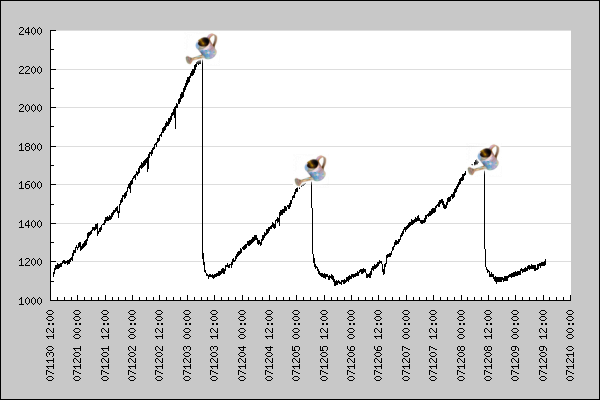
I water the plant every few days, as indicated. It would be fun to extend this into a full-blown irrigation system by building some kind of motorized watering contraption, but I don't want to risk the wooden floor. =)
How the sensor works
This is the world's cheapest ohm-meter:
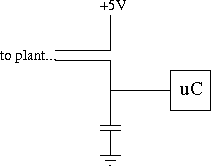
The microcontroller drains the capacitor by providing a 0V output on the pin. It then re-configures the pin into a high-impedance input pin and resets an internal clock. Now the capacitor is slowly charged through the resistor (soil), and when the voltage level has become so high that it corresponds to a logical 1, the microcontroller receives a pin change interrupt, reads the clock and reports this value to the computer.
Posted Wednesday 9-Jan-2008 17:20
Discuss this page
Disclaimer: I am not responsible for what people (other than myself) write in the forums. Please report any abuse, such as insults, slander, spam and illegal material, and I will take appropriate actions. Don't feed the trolls.
Jag tar inget ansvar för det som skrivs i forumet, förutom mina egna inlägg. Vänligen rapportera alla inlägg som bryter mot reglerna, så ska jag se vad jag kan göra. Som regelbrott räknas till exempel förolämpningar, förtal, spam och olagligt material. Mata inte trålarna.
Mon 31-Mar-2008 14:43
Current flows. Electrolysis will happen. The electrodes will dissolve over time. There's a magnetic field, etc.
9 more comments hidden. Click to show all.
Fri 23-Jul-2010 20:17
I've always thought the same thing. I've been dreaming about an automated greenhouse. I have all the control side down, but the moisture sensing circuitry was a little bit of a problem for me.
Thanks to you, I have that almost all figured out. The next step is to blend the sensing and controls together.
The problem I'm having is to get an output signal send to the controller once a setpoint is reached.
Thanks
p.s. you can really mislead someone with the title "pot plant" hehe
andrerouellette@gmail.com
Andre
Mon 7-May-2012 13:49
once you know the 'ideal' weight for the moist level that the plant needs.
to dry then switch on a little airpump (aquarium pump) that pushes the water out of a closed jar, or a stepper motor pump (like in the old xerox inkjets) that pushes the fluid trough a medical rubber tube.
Tue 5-Jun-2012 05:07
Sun 13-Oct-2013 06:37
How do you account for the plants growth?